
Yes, he is one of the five Georgia Martyrs. Our fellow countryman, from the town of Chozas de Canales in Toledo, Friar Miguel Antón, known in America as Friar Miguel Añón, is currently awaiting beatification, along with his four companions. All of them were Friars Minor of the Order of Saint Francis (OFM). An official date has been set: it will take place on October 31, 2026, in Savannah, Florida, USA.
On September 17, 2026, the 429th anniversary of the martyrdom of Friar Miguel Antón (Friar Miguel Añón, as he is known in the Americas) and Friar Antonio de Badajoz was commemorated. The latter was a lay brother (not a priest) who evangelized alongside our fellow countryman at the mission on Santa Catalina Guale Island in Florida (USA). The Guale Indians, native to that area, had rebelled against the Franciscan friars because they were not allowed to have more than one wife (they practiced polygamy) after having been baptized and embraced the Christian faith. All five of them, the Five Martyrs of Georgia, lost their lives in September 1597 as a result of the Guale Indian revolt. The Guale Indians inhabited this ancient American region, which today forms part of the state of Georgia (USA).
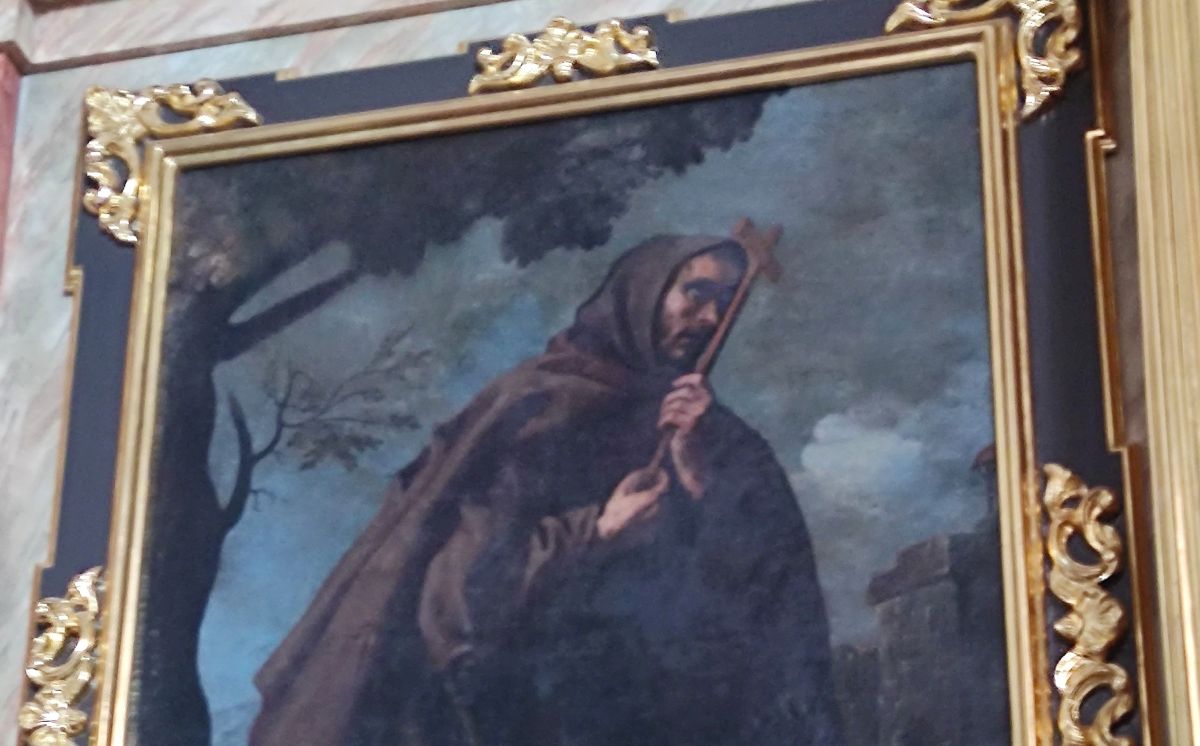
(In the opening photograph, a Franciscan friar is about to kiss a cross. I have chosen a fragment of the painting that is currently displayed on the High Altar of the Parish Church of Santa María Magdalena in Chozas de Canales, Toledo.)
On October 31, 2026, in Savannah, Georgia (EE.UU.), in the year of St. Francis of Assisi, the five Spanish missionaries who suffered martyrdom in Florida in the 16th century for defending Catholic marriage will be beatified. The ceremony will be presided over by Cardinal Frank Leo, Metropolitan Archbishop of Toronto, representing Pope Leo XIV. This year also marks the 800th anniversary of the death and passing of St. Francis (1226-2026). A beautiful way to commemorate the Franciscan year: 5 of its Friars Minor are to be beatified, after the meritorious work to achieve it, carried out by the American church of Georgia.
In September, specifically on September 17th, is the day that Friar Miguel Antón (Añón) suffered martyrdom, and it is also the day we celebrate the mystery of the Stigmata of Saint Francis of Assisi. And one more interesting fact: the Hermitage of Christ of Mercy in Chozas de Canales (Toledo, Spain)—the town in Toledo where Friar Miguel Antón was born—a small church originally belonging to the Marquises of Canales, is also Franciscan. And now, a brief note about these nobles. Pedro Coloma Novajas, Secretary of War and of the Universal Office during the reign of Philip IV, had purchased the lordship of the town of Chozas de Canales and its jurisdiction on January 26, 1643, the entailed estate of which was inherited by his eldest son, Pedro Coloma y Escolano. He received the title of Marquis of Canales de Chozas in 1680, granted by King Charles II. When the first Marquis of Canales died without issue, his brother Manuel Coloma y Escolano inherited the title as the second Marquis of Canales. From him, the title passed to his only daughter, María Teresa Coloma Serdás de Tilli, the third Marchioness of Canales. After becoming a widow and losing the child she was expecting, she entered the Cistercian convent of San Joaquín and Santa Ana in Valladolid.
I recently discovered the meaning of the symbol of the five wounds of Saint Francis in the coffered ceiling of the altar, just above the head of our Christ of Mercy. Our hermitage is Franciscan! The hermitage that originally belonged to the Marquises of Canales.
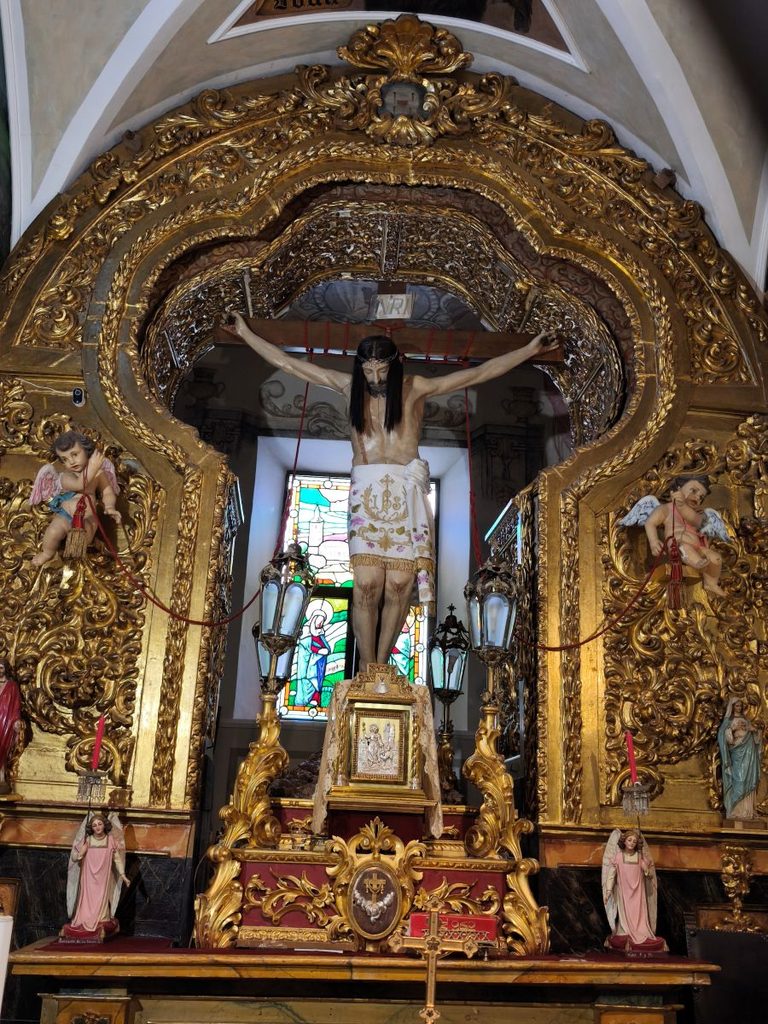
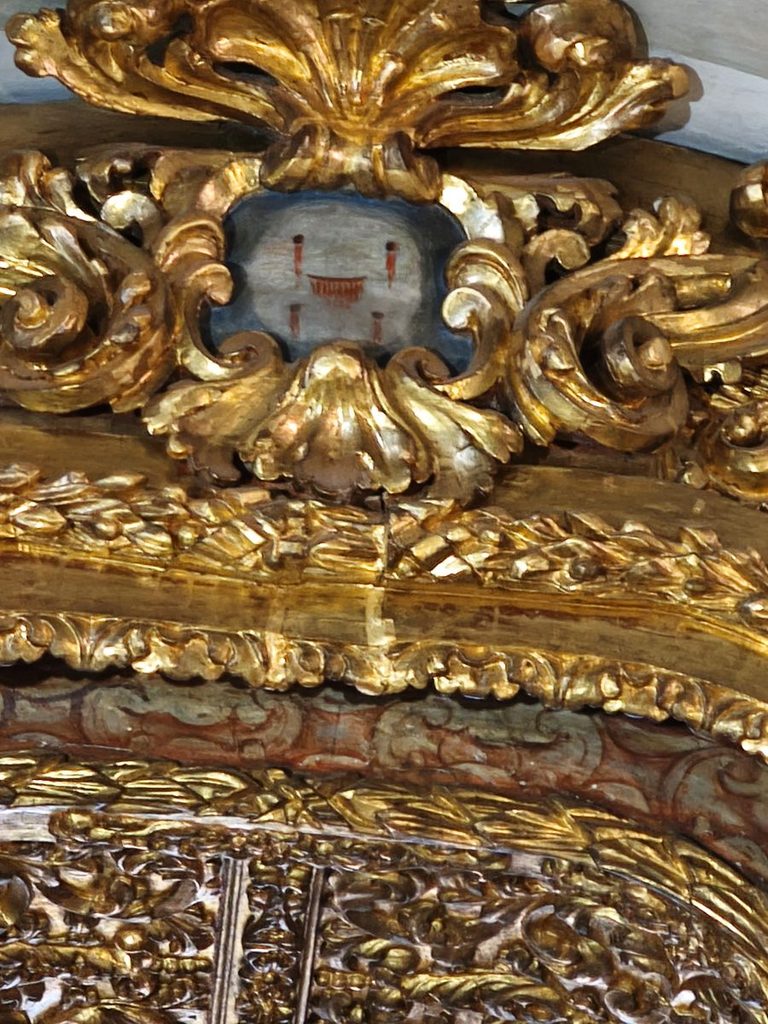
When Pedro Coloma Novajas, the Marchioness’s grandfather, bought numerous lands in the village, only a little over 45 years had passed since the martyrdom of Friar Miguel Antón in Florida. Perhaps because of the recentness of that event, or perhaps due to their own devotion—given that the Coloma family was very pious—this noble family, originally from Navarrete in La Rioja, decided to dedicate the hermitage they had built, which was directly connected to their palace, to Saint Francis of Assisi.
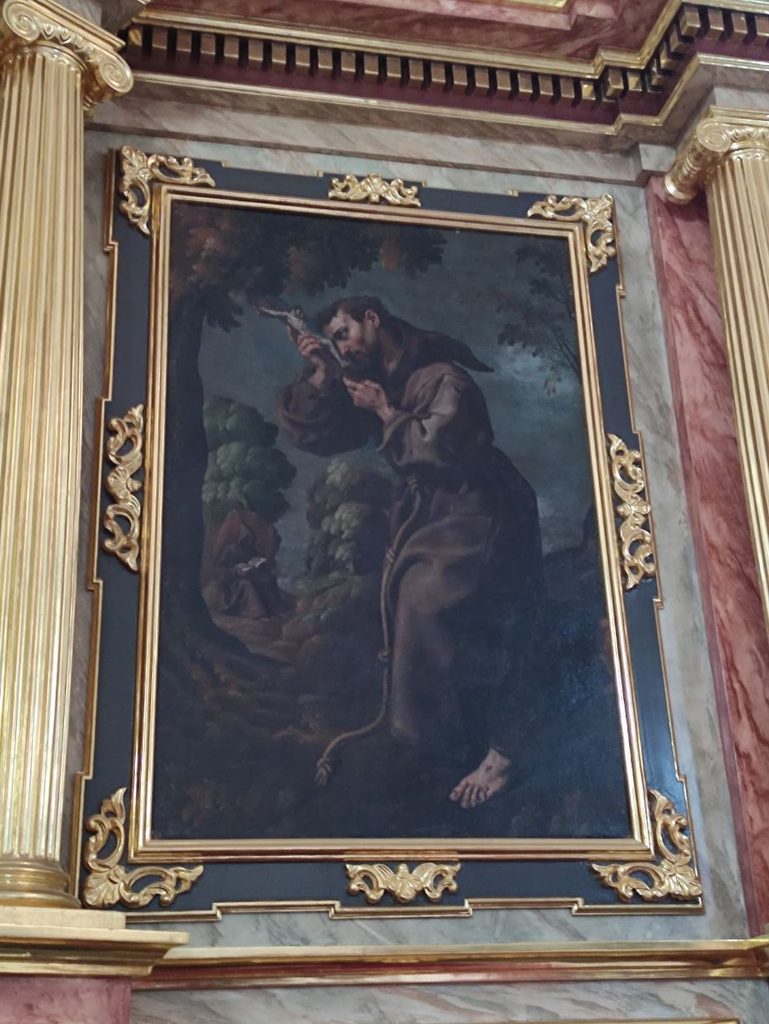
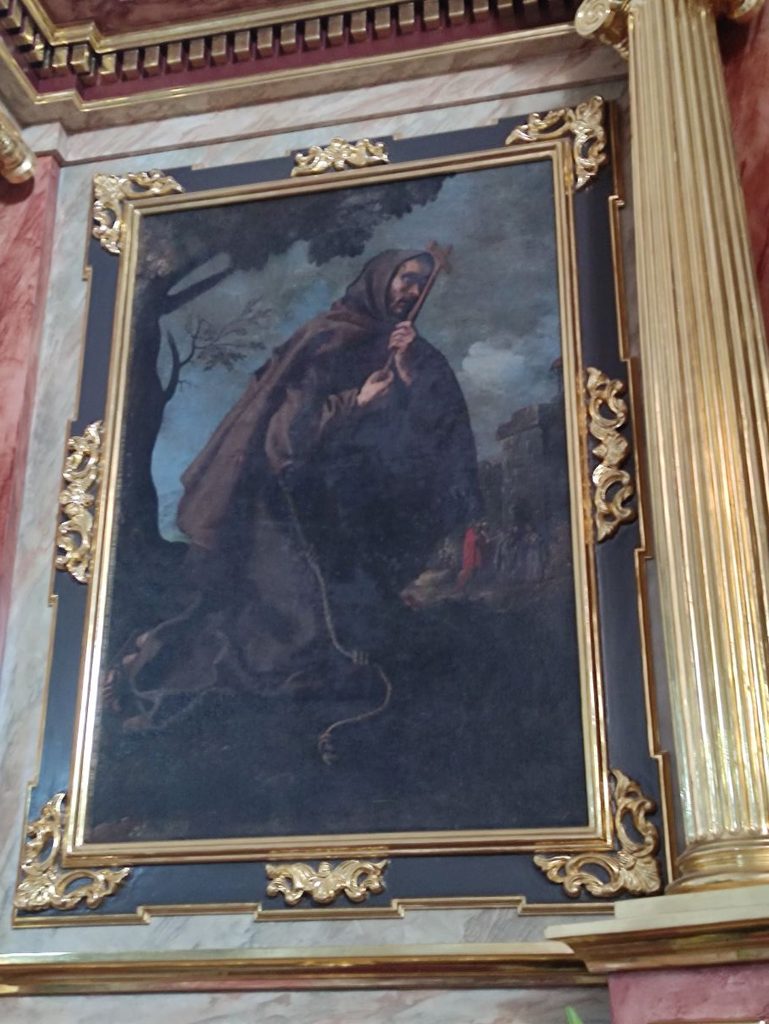
In fact, two paintings are preserved on the main altar of the village’s parish church: one of Saint Francis of Assisi, where the stigmata are visible, and another of a Franciscan friar about to kiss a cross. The latter most likely originated with the Marquises of Canales. These canvases may have been inspired by the death of Friar Miguel Antón in the Americas. That is to say, the Lord of Canales, Pedro Coloma Novajas, or perhaps one of his two sons, Pedro or Manuel Coloma Escolano, Marquises of Canales, commissioned them after learning the story of Friar Miguel Antón. Both paintings, whose original location must have been the Marquises’ original hermitage, were recently moved from the Hermitage of Christ of Mercy to the altar of the parish church of Saint Mary Magdalene, where they remain today.
In the 16th century, three very important Franciscans were born in the village of Chozas de Canales: Friar Miguel Antón (Fray Miguel Añón, baptized on May 20, 1570), Friar Pedro Fernández de Chozas (baptized on June 8, 1572), and Sister Juana de San Antonio (baptized on February 3, 1588), a Poor Clare nun. The Order of Saint Clare was founded in the 13th century (1215) by Saint Clare of Assisi, with the guidance and support of Saint Francis of Assisi. Our Poor Clare nun was also a Franciscan. In our village, children were baptized a few days after birth, so the dates of their baptisms tell us the year they were born.
Found in Florida, by
Friar Alonso de Escobedo
Experts and scholars of the events that took place in Florida in 1597—the martyrdom of these five religious figures and the fact that a sixth friar, Friar Antonio de Ávila, was taken prisoner by the Native Americans—say that the best source for understanding what happened in those missions is a book of poems called La Florida, written by another friar, Friar Alonso de Escobedo. This friar and poet was also in those lands when the events occurred. Fortunately, this book of poetry, a true gem, is preserved in our National Library in Madrid, Spain.
It is there that I clearly found our Friar Miguel Antón. In La Florida, Escobedo lists the friars who had arrived in America on an expedition in 1595, and curiously, on a ship called the San Francisco. And Friar Miguel appears second on the list. It is an ordered relationship, without a doubt, he numbers them one by one.

5 Fray Gregorio.
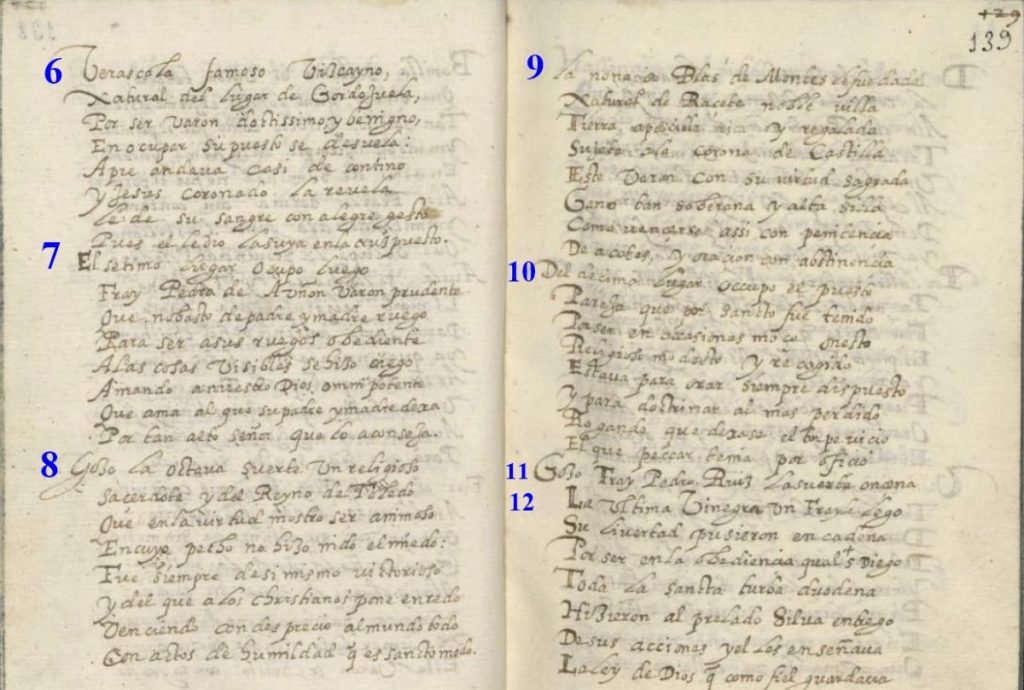
2 One was from Chozas de Canales,
Which Chozas was named after his village,
Whose immortal heroic words,
Because they are so great they cause wonder:
Not only to the men of the East,
Who occupy the entire Kingdom of Castile,
But to the people of the West:
His knowledge, life, and doctrine are admired.
Which Friar Miguez Rez takes as his name Antón
Such a profound scholar of theology
That in the schools he was of great renown
He was the best singer that there was in the world
Never was such a voice heard in a pure man
Because of his fame it grew
For for Christ Jesus he will give his life.

This is indicated on this double page, numbered 138 on the right. On the previous page, 137, the chapter title and introduction state the following:
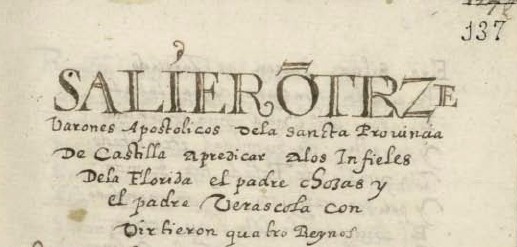
Thirteen came out
apostolic men from the Holy Province
of Castile went out to preach to the infidels
of Florida; Father Chozas and
Father Veráscola converted
four kingdoms.
Friar Alonso recounts, before giving the numbered list we saw earlier, that thirteen Castilian Franciscan friars went out to preach the faith of Jesus to the pagan barbarian infidels. And he indicates in that chapter that Silva was their prelate, whom they followed. And when later, on other pages, he recounts other events, such as a trip they made to Tama, and states that Father Chozas led this incursion, he is actually referring to Friar Miguel Antón and not to Friar Pedro Fernández de Chozas, his fellow countryman. Some authors mistakenly believe that the man who accompanied Friar Francisco de Veráscola—called the «Cantabrian giant» because of his height—was Friar Pedro Fernández de Chozas, having read «Father Chozas» in the poem that Escobedo mentions. Along with the two friars, a soldier named Salas also went to Tama as an interpreter of the indigenous language. Their objective was to explore new territories to evangelize, new peoples, and new lands.
Regarding the fact that thirteen friars set out—while only twelve are mentioned—the explanation can be found in the passenger list of the San Francisco, the ship on which they traveled. It was initially stated that thirteen friars and two servants would make the journey; however, it is known that one of the friars fell ill and did not board the ship bound for Florida.
In the village of Chozas de Canales, it has always been known that one of our countrymen, in the 16th century, lost his life as a missionary in Florida: Friar Miguel Antón. Finding him in this work by Friar Alonso de Escobedo is, indeed, a blessing. Many authors have interpreted the friar’s name as Añón, because Escobedo, and many 16th-century writers, used abbreviations that seem very strange to us today. In this case, Escobedo never uses the letter ‘t’ in ‘Antón’ in his work La Florida; he always uses the tilde between the ‘n’ and the ‘o’, but never places it over the ‘n’… He did this to avoid writing the letter ‘t’. It is not an ‘ñ’, as has been misinterpreted.
Friar Pedro Fernández de Chozas
Furthermore, there is another circumstance that has led to confusion regarding the figure of Friar Miguel Antón (Miguel Añón). On the same 1595 expedition was another Franciscan friar, also born in Chozas de Canales, Fray Pedro Fernández (two years younger than Fray Miguel). What a coincidence! Coincidences do happen. We in the town of Chozas de Canales had completely lost track of this friar; he had been forgotten in our history. This second friar was also from Chozas de Canales, and the first to mention it, adding «de Chozas» after his name and surname, was the Governor of Florida, Gonzalo Méndez de Cancio, in several of his writings or accounts of what happened (these are preserved in the General Archive of the Indies, Seville. I have seen them with my own eyes). The Governor notes: Pedro Fernández de Chozas. Another author, years later, Luis Jerónimo de Oré, in his work Relación de los mártires que ha habido en la Provincia de La Florida (around 1616), a work housed at the University of Notre Dame (Indiana, USA), also indicates that Friar Pedro Fernández was from our town… He also says: Pedro Fernández de Chozas. I am also studying and reading passages from that work.
There is another reason for the confusion. Researchers studying these events could not find Fray Pedro Fernández de Chozas in the list provided by Fray Alonso de Escobedo in his work, La Florida. He is not mentioned by name, which is why they could not find him. However, various scholars had noticed that the town of Chozas de Canales was mentioned, as we have seen previously. And they concluded that Fray Pedro might be in the two paragraphs Fray Escobedo wrote about Fray Miguel Antón. The name of the town of Chozas de Canales is written there. We have seen it listed as number 2.
In reality, Fray Alonso de Escobedo does not name Fray Pedro Fernández, perhaps because he was less familiar with him. Or perhaps this is another of his oversights. He does indicate in his numbering that the eighth friar was from the province of Toledo, like Fray Pedro Fernández. Curiously, in the list of the twelve religious figures, Fray Pedro Fernández is the only one not named.
It reads as follows (I interpret this as referring to Fray Pedro Fernández, logically):
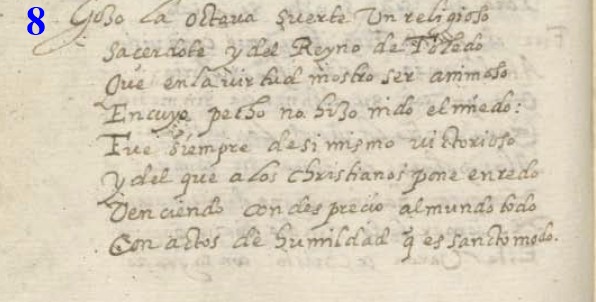
The eighth lot was won by a religious figure,
A priest from the Kingdom of Toledo,
Who showed courage in virtue,
In whose heart fear never took root:
He was always victorious over himself,
And over the one who entangles Christians,
Conquering the whole world with contempt,
With acts of humility, which is a holy way.
This must be, by process of elimination, Fray Pedro Fernández de Chozas. All the others are named. There are no other possibilities: 1. Prelate or Commissioner Silva. 2. Miguel Antón (or Miguel Añón, for the Americans). 3. Bonilla. 4. Ávila. 5. Gregorio. 6. Veráscola. 7. Pedro de Auñón. 8. Priest from the Kingdom of Toledo. 9. Blas de Montes. 10 Pareja. 11 Pedro Ruiz. 12 Viniegra. The eighth is the only one not named, bad luck. It would have helped us a lot if he had. There is only one left, this one: Friar Pedro Fernández, who was from Toledo (Chozas de Canales is a town in Toledo), a priest, and was on the same expedition as Friar Miguel Antón, the one of 1595.
The Chaplaincy of the
Cleric Friar Pedro Fernández
I wondered if we had any proof that Friar Pedro Fernández de Chozas was actually born in Chozas de Canales and if he had any connection with the town upon his return to Spain. And I found it. In 1572, a boy named Pedro Fernández was also born in our town. I found his Baptismal Certificate in our First Book of Baptisms in the Parish Archives, which, as I mentioned before, took place on June 8, 1572. Quite a discovery. However, there was some doubt that it might be the Baptismal Certificate of another Pedro Fernández, as it is a fairly common name and surname. Recently, I found further evidence confirming that it was indeed him… This friar, according to what we have read in other sources—various websites of American churches—did not die in Florida; his mission was on the island of San Pedro. And he was the first to write an account of what had happened: the deaths of the religious figures, in a letter addressed to the Governor, Gonzalo Méndez de Cancio. He did so with the initial information he had at the time.
This friar returned to Spain shortly after these events, the deaths, to report what had occurred to the king, and in 1612 he went to Rome to report on the martyrdoms, returning as «Commissary General of Jerusalem,» as Father Oré recounts in one of his works. He also held the position of Commissary of Madrid.
As expected, upon his return he maintained contact with his hometown in Toledo, where his family continued to reside. The town is very close to the capital, where he likely lived, given his position as Commissary of Madrid. In our Parish Archives, I found a document from 1598 or 1599 indicating that Friar Pedro founded a chaplaincy in our town…
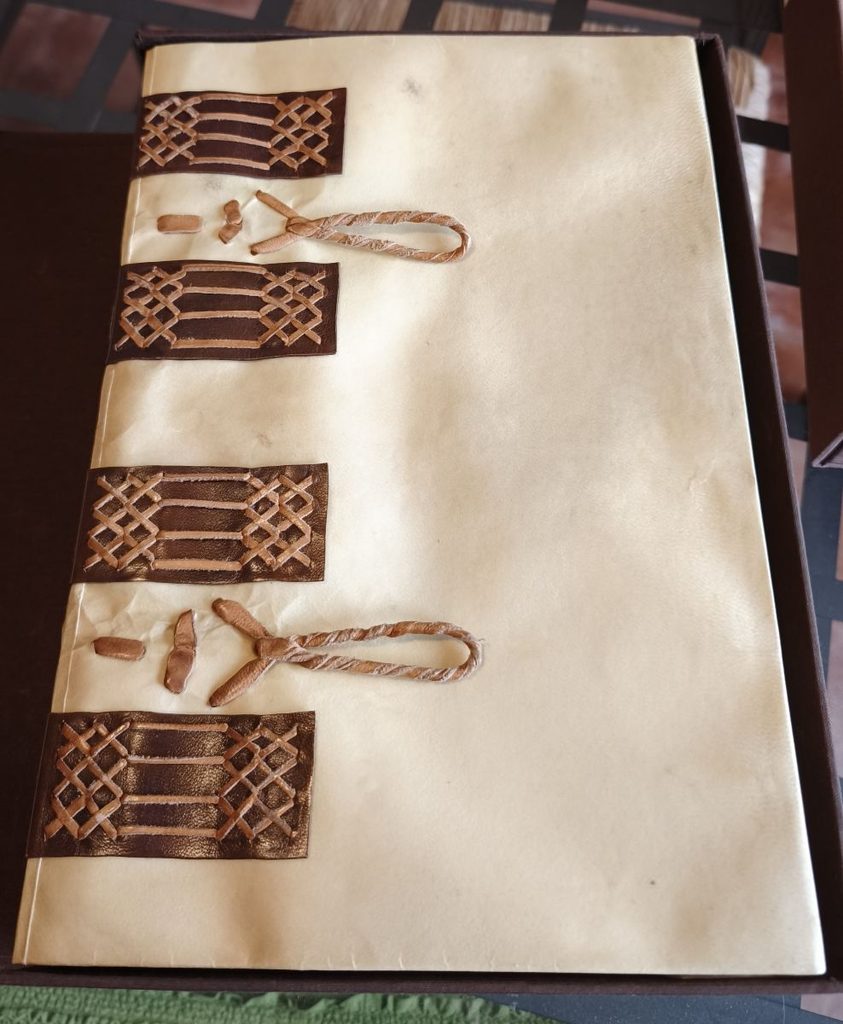
Looking for some evidence… I returned to the Parish Archives to examine a folder of documents labeled as an annual report. Would I find anything about him or Friar Miguel in it? Unfortunately, the original handwriting of these manuscripts is barely legible, as we can see in the two photographs below. But luckily, someone had annotated the contents of those old handwritten pages on some sheets of paper bearing a bank logo, in perfectly legible handwriting. They only summarize the topics; they don’t reproduce everything verbatim. And Pedro Fernández, a clergyman, appears in those pages.
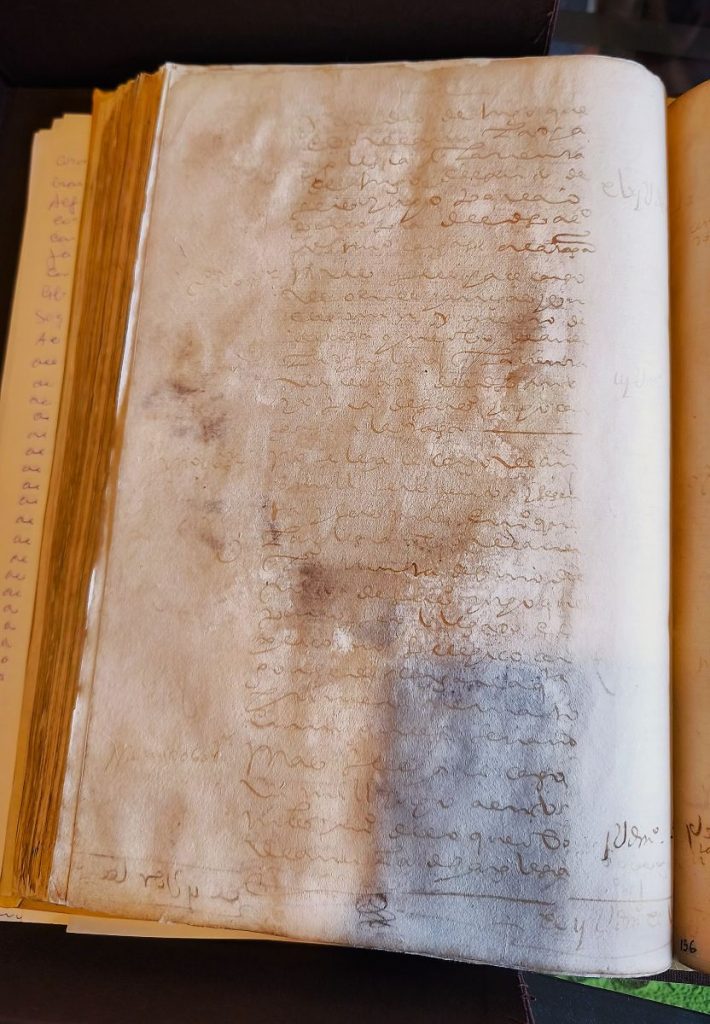
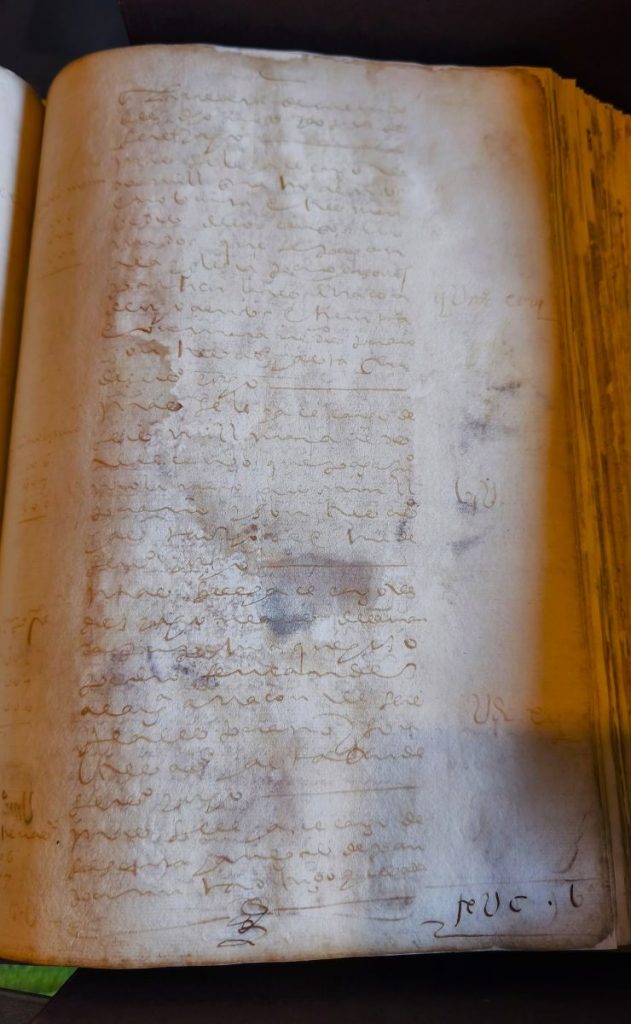

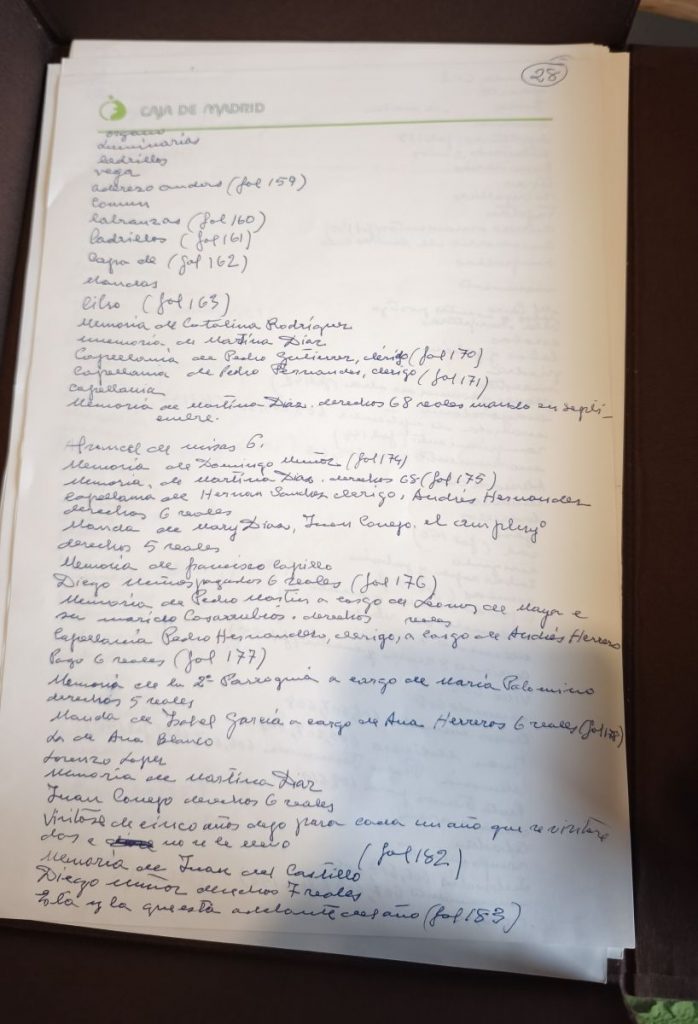
I recalled that a priest from the town, Don Pascual José Carvajal Gallego (parish priest from 1965 to 1972), went to the Toledo School of Translators on occasion, for example, seeking help or translation of a document for another matter. It could have been him who sought some assistance or who glimpsed what is written there. The fact is that someone wrote on a folio numbered 28 that on one of the pages of that annual compilation, page 171, there was information about a Chaplaincy of the Cleric Pedro Fernández. They had found the Franciscan friar known as Pedro Fernández de Chozas connected to our Parish.
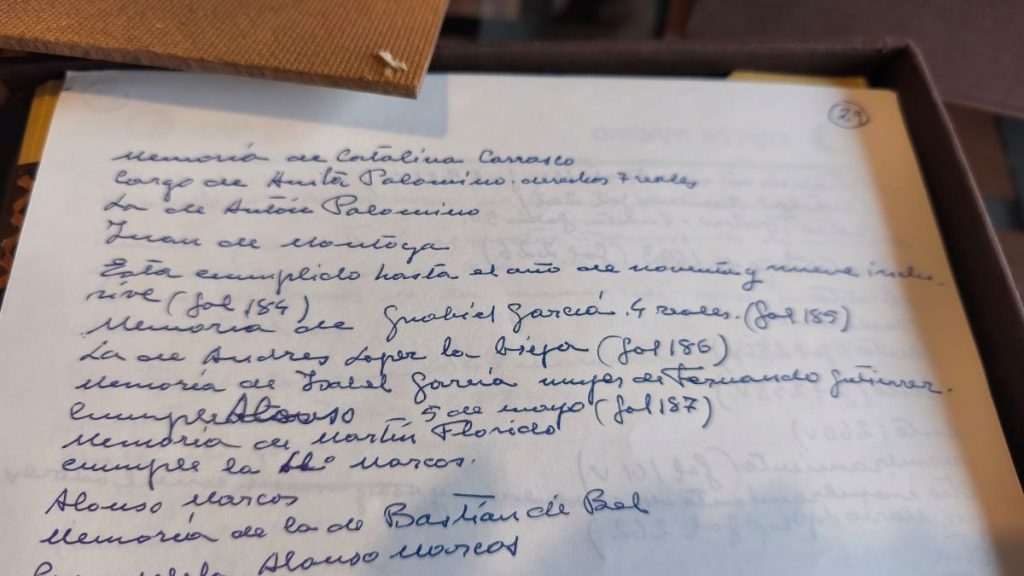
On the following folio, 29, it states that the preceding pages go up to 1599. This leads us to deduce that the entry mentioning the cleric Pedro Fernández refers to the year 1598 or 1599. Around that time, Friar Pedro Fernández was already in Spain, having returned from America after his martyrdom. This clear mention in the Annual Report of our Parish is proof that Friar Pedro Fernández «de Chozas,» who appears in the book of Friar Gerónimo de Oré and in the old documents written by Governor Méndez de Cancio, was born in Chozas de Canales, as was Friar Miguel Antón.
Friar Miguel wasn’t from Aragon,
he was from Chozas de Canales
Returning to our martyred friar, there’s another chapter that has misled many researchers, both national and international… Escobedo, after introducing the twelve religious figures, from page 138 to page 149… states that Friar Miguel was Aragonese. Impossible, but… I read it again and again. Until a doubt arose. What if both were true? He was born in Chozas de Canales, but his family was from Huesca. That fits, that must be the truth. In Spain, it’s very common to say where you’re from, and in this case, to later specify your family’s origin, even if it’s not the same place. For example, in Madrid, where people come from all over the country, children may have been born in the capital, but if asked, you immediately say, «But my parents and/or grandparents are from Toledo, or Segovia…» There are films that illustrate this, like «Spanish Affair» («Ocho apellidos vascos»… to be considered Basque. I believe that’s the meaning Fray Alonso de Escobedo conveys in that chapter.
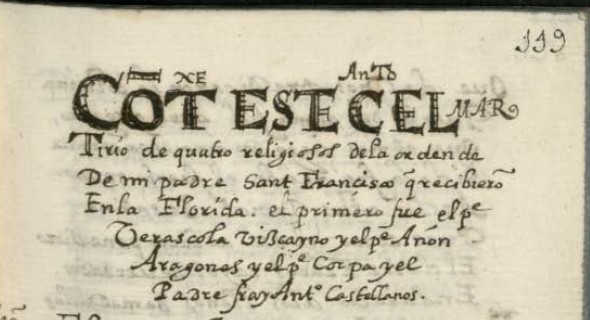
Canto Fourteen. The Martyrdom of Four Religious of the Order of
Of My Father Saint Francis, who received
In Florida, the first was Father
Veráscola, from Biscay, and Father Antón
from Aragon, and Father Corpa, and
Father Fray Antonio Castellanos.
Note the tilde he uses when writing Antón, right between the n and the o. It is not placed over the n, as is very clear. It is not: ñ. He should have written Father Antón, from Toledo, or perhaps «from Chocero,» but he preferred to say where his ancestors, the «Antones,» his father and grandfather, were from.
We see other abbreviations in this chapter introduction, with tildes, such as the one that appears next to the q to represent that… Or when he writes «received,» with the tilde after the letter o, without the n. We also noted several surprising observations: Not four religious men died, but five. Friar Blas Rodríguez is not mentioned. This omission is incomprehensible. The text states that the first martyrdom was that of Friar Francisco de Veráscola, when in reality he was the last of the five friars to die. Friar Miguel, whom it clearly indicated on page 138 was from Chozas de Canales (Toledo), is now described as Aragonese. Friar Antonio is described as Castilian, when he is known as Friar Antonio de Badajoz, Extremadura.
Some authors have indicated that Fray Miguel was Aragonese after reading this chapter, completely forgetting the account previously given by Fray Alonso de Escobedo, which began on page 138… What is the reason for ignoring the perfectly numbered account he had made earlier? Just like that. Perhaps in this chapter Escobedo points out a half-truth. Both facts could be true. Fray Miguel was born in Chozas de Canales, “which Fray Chozas was named after,” and furthermore, his family’s origin could have been in Huesca. In this chapter, he’s talking about family origins… Fray Miguel Antón’s ancestors must have been from Aragon… And this is a fact that Fray Alonso de Escobedo knows, having met Fray Miguel personally.
Prosapia
In this chapter, I found a word that led me directly to this conclusion: prosapia, which means ancestry, lineage, or family of a person. According to the Royal Spanish Academy (RAE), the term is used in a formal or literary sense to refer to the family from which someone descends. 1. Ancestry, lineage, or generation of a person. Synonyms: ancestry, lineage, stock, lineage, family, nobility…
So Fray Alonso de Escobedo, who at this time was also in Florida, at the mission in Nombre de Dios, near the city of St. Augustine, and who must have known Fray Miguel Antón quite well, knew his origins, where his father and grandfather were born. They must have been from Aragon. This does not contradict what I mentioned earlier when I introduced him on page 138, indicating the town in Toledo where he was born: Chozas de Canales. Incidentally, this same word, «prosapia» (lineage), in one of its meanings also leads us, or can lead us, to the noble origin that some authors have attributed to Fray Miguel… Valiant lineage of Antones, son of Antón, a prudent man.
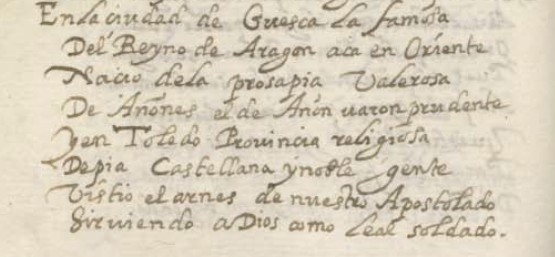
In the city of Huesca, the famous
Of the Kingdom of Aragon here in the East
Born of valiant lineage
Of Antones, son of Antón, a prudent man
And in Toledo, a religious province
Of pious Castilian and noble people
He donned the armor of our apostolate,
Serving God as a loyal soldier.
In this chapter, he is speaking of lineage, of his ancestry. Born of Aragonese descent. As we have already pointed out, Friar Alonso de Escobedo must have known Friar Miguel quite well, and that is why he knows other details about him, in addition to his birthplace, which he had already mentioned. In this chapter, he refers to his ancestry in a somewhat poetic way. But he indicates that he is speaking of lineage and that it was in Toledo where he donned the armor of the apostolate, very possibly in the Franciscan convent of Ocaña. There are old writings that refer to him as Fray Miguel de Ocaña (I know this because I have seen some of them in the Franciscan Archive of San Francisco el Grande). I believe that in those cases they are indicating the Toledo convent where Fray Miguel professed his vows, the Royal Monastery of Our Lady of Hope. Sadly, it was destroyed during the War of Independence in 1809, during the French invasion.
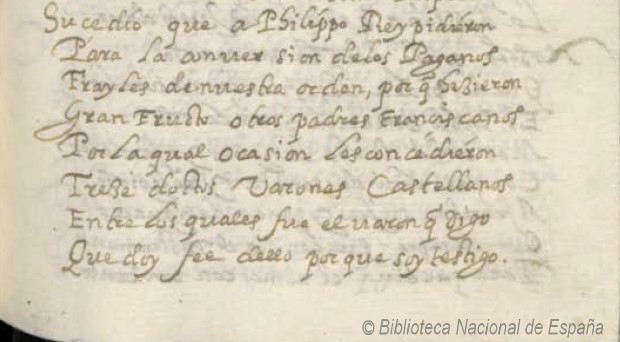
It happened that King Philip asked
For the conversion of the pagans
Friars of our order, because
Other Franciscan friars had borne great fruit
For which reason he granted them
Thirteen learned Castilian men
Among whom was the man I mention
Which I attest to because I am a witness.
He is speaking here of Friar Miguel. It is not that others told him this; he has a direct source regarding what he recounts about Friar Miguel, «I know it because I am a witness.» That is why his work, La Florida, is considered the best source for understanding what happened. It is a primary source, despite having some incomprehensible lapses, such as forgetting Friar Blas Rodríguez. Or not mentioning Friar Pedro Fernández by name when he writes the list of friars.
The martyrdom of Friar Miguel Antón, Friar Miguel Añón, in La Florida de Escobedo
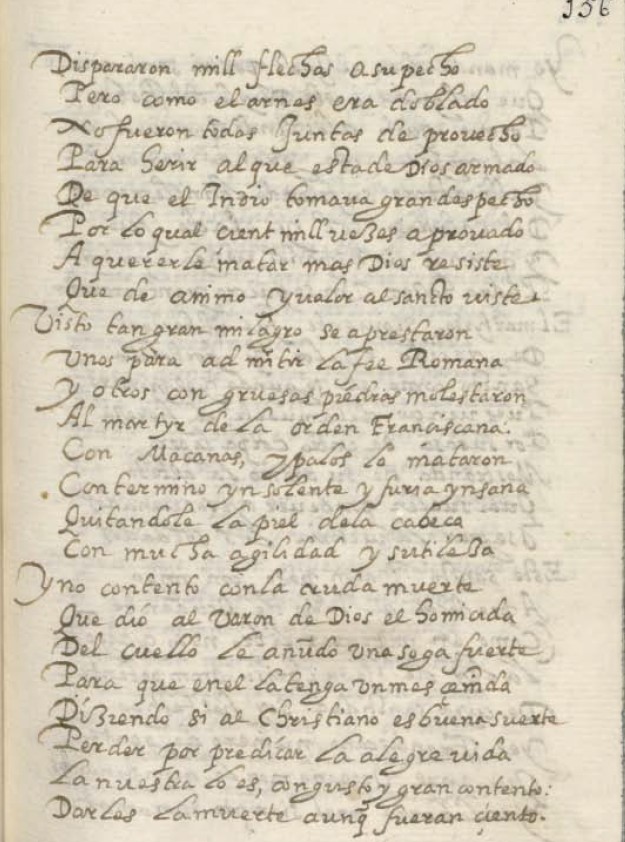
He details it on page 156 of La Florida, which is in the ©National Library of Spain in Madrid. Sadly, he recounts it thus:
They shot a thousand arrows at his chest
But since his armor was doubled
They were not all effective
To wound him who is armed by God
Which would cause the Indian great resentment
For which reason he has tried a hundred thousand times
To kill him, but God resists
For he clothes the saint with courage and valor.
Seeing such a great miracle, some prepared
To accept the Roman faith
And the others harassed
The martyr of the Franciscan order with large stones.
With clubs and sticks they killed him
With insolent intent and insane fury
Removing the skin from his head
With great agility and subtlety.And not content with the cruel death
That the murderer inflicted on the man of God,
Around his neck he tied a strong rope
So that it would hang there for a month, asking if it is good fortune for a Christian
To lose for preaching the joyful life
Ours is, with pleasure and great joy,
To give them death, even if there were a hundred of them.
Friar Alonso de Escobedo already considered Friar Miguel a saint and martyr, something he mentions several times in his work. He recounts that he was shot with arrows, that his scalp was torn out, something the Indians commonly did in their battles, and that they considered the scalps as trophies. Sometimes they wore the scalps tied to their legs in a kind of garter. And they also gave them as prizes for their feats or competitions. A person could have their scalp taken, but not die at that moment. He notes that they wounded him with stones and macanas. The latter are stone axes. Thus lost the life of our countryman, Father Chozas. Rest in peace, our martyr.
The Beatification of the
5 Martyrs of Georgia
Will take place on October 31, 2026, All Saints’ Eve, in Savannah, Georgia, USA. The beatification liturgy will be presided over by Cardinal Frank Leo, Metropolitan Archbishop of Toronto, Canada, representing Pope Leo XIV as papal legate. The Bishop of Savannah, Stefen D. Parkes, has already announced the date of the beatification of the 5 Martyrs of Georgia, noting, «Their beatification will be a date of great importance for the faithful of the Diocese of Savannah and the Archdiocese of Atlanta«. Bishop Parkes also highlighted the symbolism of the beatification date, coinciding with the Jubilee Year of St. Francis of Assisi: “The year is also noteworthy, as these Franciscan friars will be declared ‘blessed’ while the Catholic Church commemorates the 800th anniversary of the death of their order’s founder, St. Francis of Assisi, in 1226”.
The beatification Mass for the martyrs, officially scheduled for October 31 in Savannah, Georgia, will take place in a space within the Savannah Convention Center, where approximately 12,000 people are expected to attend. It will be the sixth beatification on U.S. soil and the first to take place in Georgia, according to the Diocese of Savannah.
Jill Parks, director of communications for the Diocese of Savannah, has indicated that it will be a major national and international event, judging by the number of calls they are receiving. Among those expected to attend is Savannah resident Patrick McMahon, a fourth-degree member of the Knights of Columbus, the world’s largest Catholic fraternal service organization, as he told OSV News.
Representing Spain, Archbishop Joan Enric Vives i Sicilia, Bishop Emeritus of Urgell, is expected to attend, according to Parks. Archbishop José Rodríguez Carballo of Mérida-Badajoz, who heads the archdiocese to which the lay brother Fray Antonio de Badajoz belonged, has also expressed interest in attending. The parish priest and others from the parish of Fray Francisco de Veráscola (Gordejuela, Vizcaya – sometimes spelled Beráscola) also hope to be able to attend.
And here in Spain, in the Parish of Santa María Magdalena, in the town of Chozas de Canales in Toledo, our parish priest, Father Pedro Carpintero, and his parishioners will also pay a well-deserved tribute to the five martyrs of Georgia, and a special recognition to our fellow countryman: Friar Miguel Antón.
Finally, and very importantly
Gentlemen of the Church of Georgia, with all due respect: What more do you need to recognize that the one you call Friar Miguel Añón is our Friar Miguel Antón, Miguel Rodríguez, who took the name Antón because he wanted to bear his father’s name? And that he «was born of the valiant lineage of the Antones,» who were from Huesca, Aragon… Lineage means ancestry, lineage.
In the town of Chozas de Canales in Toledo, we have always known that in the 16th century there was a Franciscan friar who was born in our town, was a missionary, and was beheaded by Native Americans in Florida. His baptismal certificate was found in the town in the late 1950s by the mayor, Álvaro Valdés Magín. We knew that he was called «Father Chozas»… A street was named after him.
On the other hand: In what is considered by numerous researchers and scholars (even universities) to be the best and most important work on the subject, La Florida, by Fray Alonso de Escobedo, a manuscript housed in the National Library of Spain, appears the name of a friar named Miguel, the second in a list perfectly presented by the author, linked to the town of Chozas de Canales… And you will continue to say that «you think he was from Zaragoza» because you don’t recognize everything else I’ve just explained, and you think his name has an ñ, when the author uses the tilde over the letter ñ to avoid writing the letter t. He does this on numerous occasions, for example with the letter q... Fray Alonso uses numerous abbreviations, contractions, and superscript letters in La Florida, and a graphic symbol added above the letter, called a diacritic or tilde.
Gentlemen, it’s not Añón, as you say. He writes An -tilde- on, and it’s Antón. It’s incomprehensible that they don’t recognize him, a real shame. I’ll make sure it’s known at the National Library of Spain, the General Archive of the Indies, and even in Rome.
What a pity. I’ll contact you again, as I have on more than one occasion (with Father Pablo Migone), through your church contacts.
And I’ll ask for your help in locating our Friar Miguel Antón, Father Chozas, who was beheaded in Florida in the 16th century, in case you can lend us a hand in finding him. (This time it’s irony; we have him perfectly located).
About the author:

Dori Rodríguez García was born in Chozas de Canales (Toledo, Spain). She is a journalist who earned a degree in Information Sciences from the Complutense University of Madrid in 1987. She began her career as an intern in the press office of Televisión Española. She worked for magazines such as Tele-Ticket, Mucho más, Cómplice, and Greca—initially under the Spanish publisher Sarpe and later under the German publisher Axel Springer. Subsequently, she continued her work at another Spanish publishing house, Globus Comunicación, contributing to titles including Bricolaje y Decoración, Brico, Cocinar Hoy, Cocina Semanal, Decoración clásica, Casas de siempre, and Cocina Ligera, where she served as editor-in-chief. She is currently the Deputy Director of the digital magazine: Nutriguia.com and Director of the website: Adoronews.com